




In Central Asia, a significant part of agricultural production is produced on the steppe and semi-desert lands and requires water for irrigation. Under conditions of global warming, a significant reduction in water volumes for irrigation is expected as a result of melting glaciers and changes in precipitation. Under these conditions, the most important aspect of adaptation of agriculture to climate change is the reduction of water consumption for irrigation.
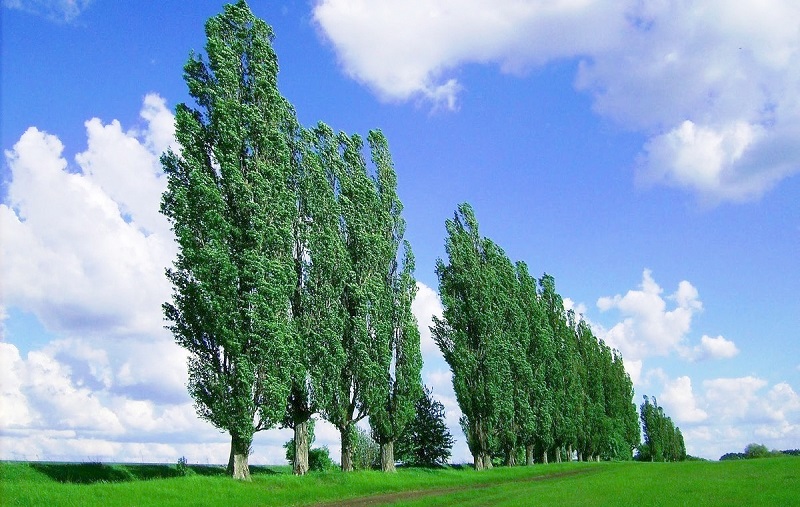
There are several ways to reduce water consumption in crop production. Many people know about drip irrigation or the transition to less water-intensive crops, for example, from the production of cotton and rice to the production of vegetables, corn, and other grain crops. The application of these adaptation measures is gradually expanding in the countries of Central Asia. However, there is another way to adapt agriculture to the conditions of climate change which is agroforestry. This method seldom comes up in discussions about climate change, although many of you have observed its application in real life. We are talking about bands of trees planted around fields, in our region, there are usually poplars and elms. One of the reasons for our ignorance is the lack of modern research or inaccessibility of information for the general public. However, such studies had been conducted in our region. At the same time, protective afforestation, in contrast to drip irrigation, can be done by the farmers themselves and without significant costs.
We would like to draw your attention to the results of one study conducted by a group of scientists from Kyrgyzstan, Germany, and Austria. It was carried out on the fields of the aul Karasai Batyr of the Zhambyl region of Kazakhstan, the villages of Temen-Suu of the Chui region, and the Chek of Batken region of Kyrgyzstan. The effect of tree bands on water consumption was produced for such crops as cotton, wheat, corn, rice, potatoes, and barley. The study took place in fields of various sizes from 50 by 50 meters to 1000 by 1000 meters. The influence on the moisture loss in the fields for protective stands from poplars planted in one strip, as well as for multi-band protective stands of poplars and / or elm, was considered.
In most of the cases studied, a decrease in water losses was observed, mainly as a result of a decrease in wind speed. The effect of tree shade on evaporation rate and the temperature was negligible. In general, the observed effect ranged from 5% to 55% and the greatest effect was observed in fields with multiband protective plantings of 50 by 50 meters and 100 by 100 meters in size.
Probably you are wondering about the level of water consumption by the trees from the protective bands. Yes, it was taken into account during the research and in some cases it gave a negative effect in the form of an increase in water consumption. This happened during the production of potatoes and wheat in the village of Temen-Suu, if a 50 by 50 meters plot was surrounded by poplars planted in several rows. At the same time, poplar grows faster than elm, therefore, in conclusion, studies are recommended as the best option - protective strips of poplars planted in one row. This will also reduce agricultural land occupied by protective tree plantings.
You can find out more about this study in the English publication - Niels Thevs, Alina Joana Gombert, Eva Strenge, Roland Lleshi, Kumar Aliev and Begaiym Emileva “Tree Wind Breaks in Central Asia and Their E ff ects on Agricultural Water Consumption”