




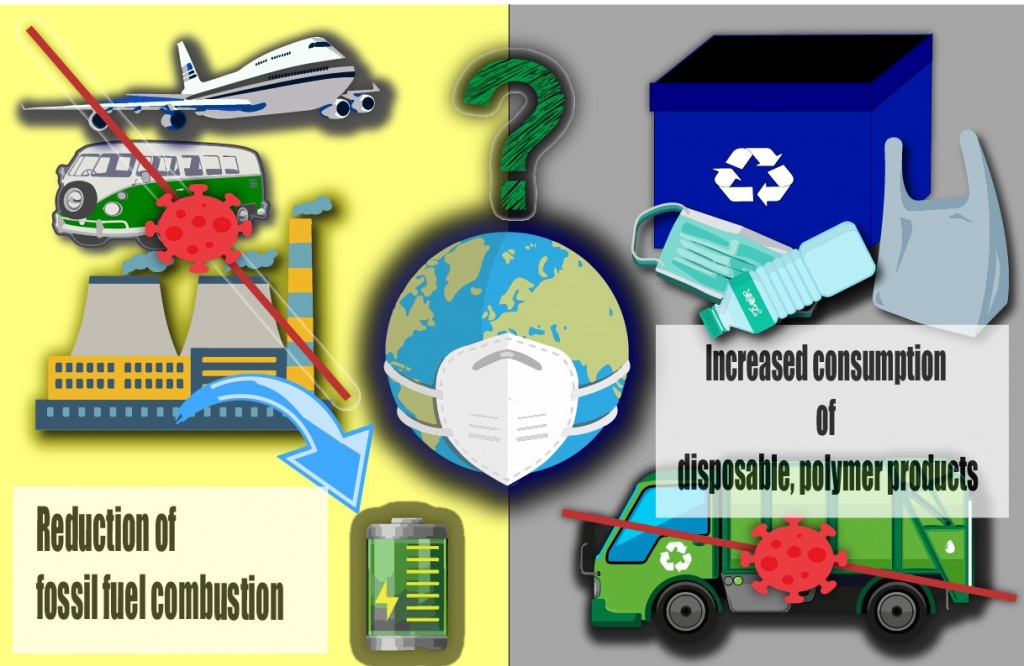
The COVID-19 coronavirus epidemic has hit the world these months. So, the measures that had been accepted in order to prevent the spread of COVID-19, such as self-isolation and quarantine, have had various environmental effects. On the one hand, there was a decrease in consumption and, as a result, in the emissions of carbon dioxide and other pollutants. Indeed, to further prevent the spread of coronavirus, air, rail, and road traffic is limited throughout the world, production and consumption volumes have decreased, and people themselves had to resort to self-isolation measures. On the other hand, the consumption of disposable polymer products such as masks, rubber gloves, and even plastic bags has increased.
The coronavirus epidemic has occurred in many countries. That is why the world has begun to draw parallels between the virus and environmental issues.
The following statistics on energy consumption reduction had been provided by a thematic group of Kazakh experts on renewable energy - SolarFestQazaqstan. So, in Nur-Sultan there was a decrease in the power load between March 15 and March 31 by 83 MW (a decrease from 276 to 193 MW). The main reason is the closure of business and budget organizations. In other regions, a decrease in energy consumption apparently occurred in April.
Similar processes took place in other countries of the world. According to some reports, the volume of electricity consumption in the Unified Energy System of Russia from March 30 to April 5 decreased by 6% compared to the previous week. This was reported by TASS with reference to the System Operator. The pandemic in China, the leader in global greenhouse gas emissions, has seen a 25% reduction in energy consumption and emissions within two weeks from the start of quarantine (compared to previous years). This reduction is related to the suspension of industrial production, a decrease in electricity consumption, and the use of transport. Thus, in early 2020, China's greenhouse gas emissions growth fell by 1%. In addition, the images from NASA satellites recorded that the concentration of nitrogen dioxide over China decreased significantly in one month, and the images of the European Space Agency markedly reduced greenhouse gas emissions over South Korea and Europe, especially over Italy. Also, according to experts, considering the current economic shocks, it is highly possible that we will observe a decrease in global carbon dioxide emissions and environmental pollution after the decline in the spread of coronavirus.
However, there are also concerns about possible environmental degradation following the decline in the spread of coronavirus. The main thesis of concern is that short-term improvements during a pandemic can further harm the environment. Due to the fact that after the widespread abolition of measures taken to curb the activity of the virus, consumption and associated emissions can again increase. In particular, this may be due to a decrease in the demand for solar energy because after the pandemic, politicians and large corporations will first resort to cost-effective, but environmentally-negative, momentary solutions and will leave out cleaner, paying only in the long-term technologies. And the financial crisis may delay the implementation of programs to reduce environmental pollution.
Along with this, there is also an increase in demand for disposable polymer products and the rejection of some initiatives to ban the use of disposable plastic. In the USA, a ban on the use of disposable plastic in the country, lobbied by eco-activists for years, has been revalued after an outbreak of coronavirus. The Governor of the State of New Hampshire urged buyers to refuse reusable canvas bags since they can serve as a place of accumulation of infections, including coronavirus, and pack products in disposable plastic bags, as they are considered the safest. And the Starbucks network forbade visitors to use reusable mugs during a pandemic.
In general, a crisis caused by a pandemic and its consequences can strike at the activities of environmental movements, such as zero waste. In particular, corporations may reject their provisions on waste recycling, replacing disposable plastic packaging with reusable alternatives. In China, the proportion of meat products and seafood sold in packaging is small compared to the United States and Western Europe, but after the outbreak of the virus, according to a report by Wood Mackenzie consulting company, the country may tighten packaging requirements for meat products, which may increase the demand for plastic packaging.
According to a BloombergNEF report, due to the high demand for medical masks and plastic packaging, the polymer industry may maintain a position or even show growth at the time of a pandemic; but overall changes in plastic demand have not yet been evaluated.
At the same time, according to some reports, in the field of plastic processing, a partial regression is observed due to a decrease in demand due to a decrease in China's industrial activity and a drop in oil prices, on which the cost of producing unprocessed plastic depends.
Thus, the overall impact of the coronavirus pandemic on the environmental aspects of our lives is mixed. A lot will depend on how our attitude to the environment changes after the removal of coronavirus restrictive measures.